

About Precast Concrete Products
CAN’BRICK, CAN’STONE, and CAN’STYLE are precast concrete products (manufactured stone veneer products).
● About Our Products
Our products “CAN’BRICK,” “CAN’STONE,” “CAN’STYLE,” and “Floor Tile” are all precast concrete products. When installed outdoors, they will change color over time due to the effects of wind, rain, and sunlight. Unlike porcelain tile or siding, please understand and accept this change as part of the product’s character before using or specifying it. CAN’BRICK, CAN’STONE, and CAN’STYLE often feature a rough-surfaced, antique-style finish, which means dust and other dirt can adhere more easily depending on the environment. In that case, please carry out appropriate cleaning and maintenance. Also, because cement is the main ingredient, efflorescence cannot be completely eliminated. When installing outdoors, after installation is complete, please apply the penetrating water-repellent agent “REPEL·S” with a sprayer, brush, or roller to reduce dirt, deterioration, and efflorescence.
● Dust and Other Dirt
Please rinse with water using a soft brush. If dirt is difficult to remove, clean with a neutral detergent.
● Delamination and Cracking
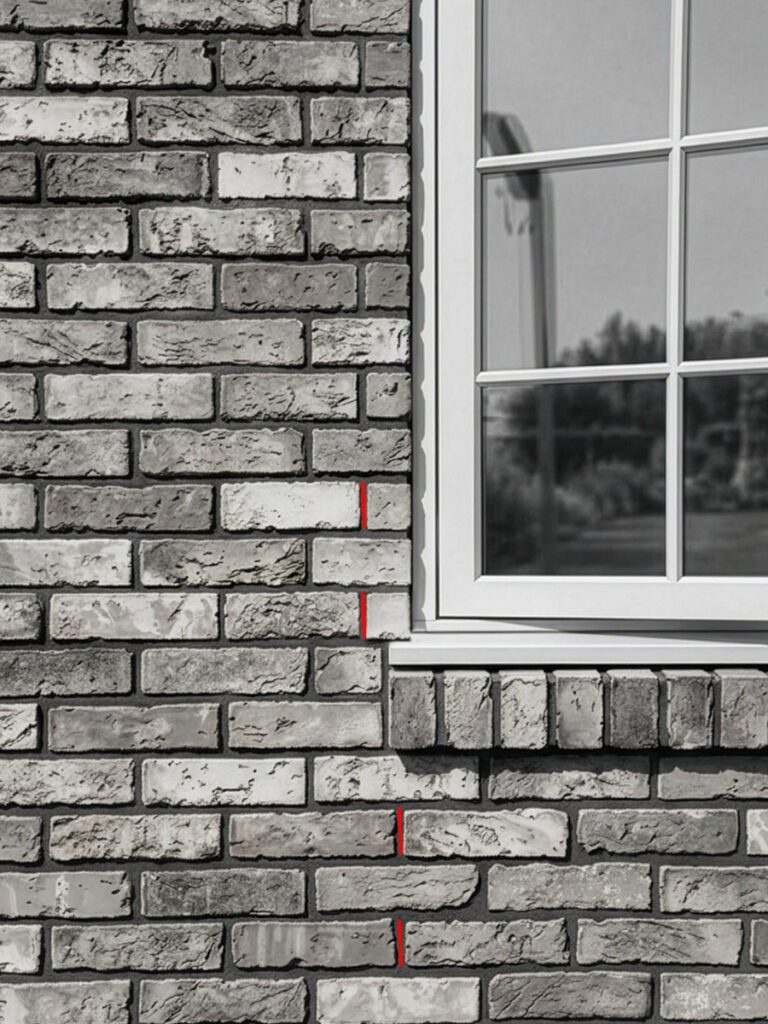
One of the defining features of precast concrete products, as decorative materials that express the look of aged brick and stacked stone, is a freedom and reproducibility of color, shape, and weight that porcelain and stoneware tile cannot achieve. A common concern, however, is delamination from poor adhesion and localized hairline cracking. The strength (flexural strength) of precast concrete products, including ours, ranks just below porcelain and stoneware tile, but fine cracks (hairline cracks) can occur due to movement from drying shrinkage or moisture expansion of the concrete or mortar substrate, or from insufficient substrate strength. To help prevent delamination, we recommend an approach that addresses both the product and the installation — from R&D to improve quality (low water absorption and back-groove shape) to recommending installation with ancillary construction materials. As a measure against hairline cracks, we recommend the flexible-adhesive installation method. Providing standard expansion joints where appropriate is also effective. Should a hairline crack occur, it can easily be repaired on the surface using our BRICK+AID, which we sell separately.
● What Is Efflorescence?
Efflorescence is the phenomenon in which alkaline components in cement (Ca2+, Na+, etc.) dissolve in water, migrate to the surface, and become visible as a white solid (mainly calcium carbonate and sodium sulfate) as the moisture evaporates. Efflorescence occurs more often in winter because the low temperature slows cement curing and moisture evaporation, making it easier for alkaline components to reach the surface of the finish material. In summer, by contrast, cement curing and moisture evaporation are faster, so less moisture migrates to the surface and efflorescence occurs less often.
● Causes of Efflorescence
Water — The effect of rainwater, etc. Gaps in the substrate or bonding surface allow moisture to accumulate, making it easier for alkaline components to migrate.
Temperature — More likely to occur in low temperatures, such as in winter, because mortar curing and moisture evaporation slow down.
Wind — Wind exposure speeds up surface moisture evaporation, making efflorescence more likely.
Installation — Gaps in the substrate or bonding surface allow moisture to accumulate, making it easier for alkaline components to migrate.
Time — More likely to occur in the early stage of the cement’s reaction, when there are more uncured alkaline components.
● Preventing Efflorescence
Do not install when rain, low temperatures, or high humidity are expected during installation or the curing period.
Always provide a slope on the finished surface and substrate to prevent water from pooling.
Install weep holes in anticipation of rainwater intrusion.
Consider using an efflorescence inhibitor in the substrate mortar.
Avoid creating voids at the bonding surface between the substrate and finish material where moisture could accumulate.
Jointing mortar is also a type of mortar and can develop efflorescence. Take care with wet-mixed joints, as they are more prone to efflorescence.
During curing, cover the work securely with sheeting to protect it from rain and wind.
After installation and curing, once complete drying has been confirmed, apply penetrating water-repellent agent REPEL·S.
We conduct ongoing research, including into the physical properties of our products, but efflorescence cannot be completely prevented in any product due to a variety of factors. That said, effective prevention is possible by addressing each of the causes one by one.
Latest Articles
View All

CONTACT
General Inquiries